Breathing is something we do every moment of our lives, yet most of the time we hardly notice it. We breathe automatically while working, walking, eating, sleeping and even talking. But when we consciously slow down and change the way we breathe, it can become a simple tool for relaxation, awareness and better stress management.
Deep breathing means taking slower, more comfortable breaths that allow the diaphragm to work effectively. It is not about forcefully filling the lungs or taking extremely large breaths. The goal is to breathe gently, slowly and comfortably.
With regular practice, conscious breathing can become a useful part of a healthy lifestyle.
Why Is Deep Breathing Important?
Our breathing pattern can change depending on what we are doing and how we are feeling. When we are relaxed, breathing is generally calmer. During stress, fear, excitement or physical exertion, breathing can become faster.
Taking a few slow breaths can create a deliberate pause and encourage relaxation.
Deep breathing may help:
- Promote a feeling of calm
- Reduce physical tension
- Improve awareness of breathing patterns
- Support relaxation before sleep
- Help you pause during stressful situations
- Improve concentration and mindfulness
- Encourage better use of the diaphragm
Breathing exercises are also commonly used as part of relaxation, yoga and meditation practices.
However, breathing exercises should complement—not replace—medical treatment when someone has a respiratory or other health condition.
7 Types of Breathing You Can Practise
There are many breathing techniques used in yoga, meditation, relaxation and breathwork. They have different purposes and should not all be practised in the same way.
1. Diaphragmatic Breathing
Also called belly breathing, this technique focuses on using the diaphragm rather than relying mainly on the upper chest.
Sit or lie comfortably. Place one hand on your chest and another on your abdomen.
Breathe in gently through your nose and allow your abdomen to expand naturally. Exhale slowly and comfortably.
The hand on your abdomen should move more noticeably than the hand on your chest.
This is one of the simplest breathing techniques for beginners.
2. Box Breathing
Box breathing uses four equal phases:
Inhale → Hold → Exhale → Hold
For example, you can gently inhale for four counts, hold for four, exhale for four and hold again for four.
You can adjust the counting according to your comfort.
This technique is often used to develop controlled breathing and focus.
If breath-holding feels uncomfortable, skip the holds and practise slow breathing instead.
3. 4-6 Breathing
This is a simple relaxation technique in which the exhalation is slightly longer than the inhalation.
For example:
Inhale for 4 counts → Exhale for 6 counts
There is no need to force either phase. Keep the breath smooth and comfortable.
A longer, relaxed exhalation can be particularly useful when you want to settle yourself after a stressful moment.
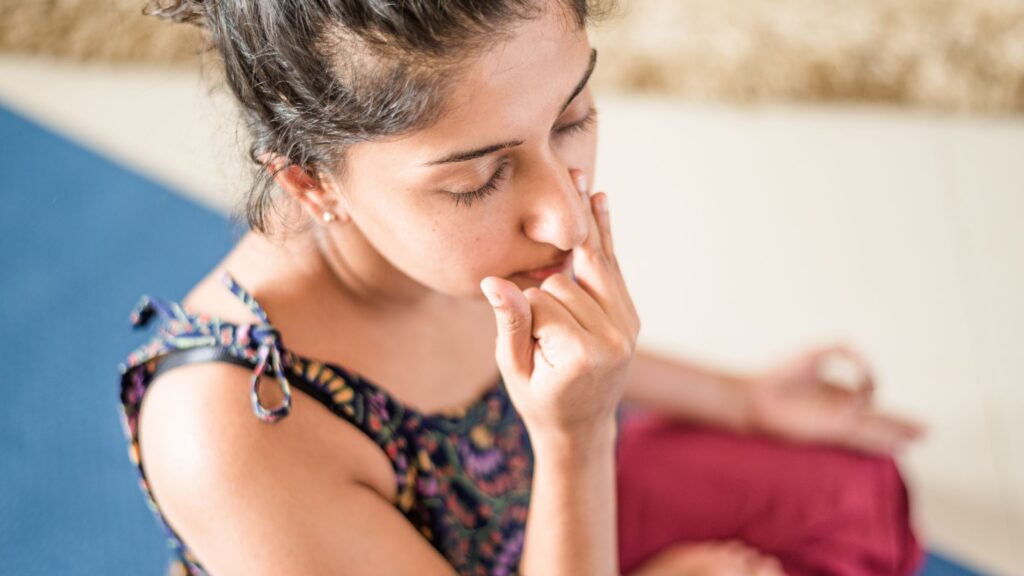
4. Alternate Nostril Breathing
Known as Nadi Shodhana in yoga traditions, alternate nostril breathing involves breathing through one nostril at a time in a specific pattern.
A simple version involves inhaling through one nostril, switching sides and exhaling through the other, then inhaling through that side and switching again.
It is commonly practised as part of yoga and meditation.
Beginners should learn the technique gently rather than forcing the breath or holding it for long periods.
5. Pursed-Lip Breathing
This technique is particularly useful for practising slower, controlled exhalation.
Breathe in gently through your nose. Then purse your lips as though you are slowly blowing out a candle and exhale gradually.
The exhalation should be relaxed rather than forceful.
People with certain respiratory conditions may be taught pursed-lip breathing by healthcare professionals, so anyone with a lung condition should follow their clinician’s guidance.
6. Resonant or Coherent Breathing
This involves breathing slowly and evenly, often around five to six breaths per minute, although the ideal pace can vary from person to person.
For example, you might inhale gently for about five seconds and exhale for about five seconds.
The goal is not to take huge breaths but to establish a smooth, comfortable rhythm.
This can be incorporated into meditation or relaxation practices.
7. Yogic Breathing Practices
Yoga includes several traditional pranayama techniques, such as Bhramari, Ujjayi, Sheetali and Kapalabhati.
These techniques are not all the same.
For example, Bhramari involves a gentle humming sound during exhalation, while Ujjayi uses a specific controlled breathing pattern. Kapalabhati involves forceful exhalations and passive inhalations and should not be treated as an ordinary deep-breathing exercise.
Because different pranayama techniques have different effects and contraindications, it is best to learn advanced practices from a qualified instructor, especially if you have a medical or respiratory condition.
How Long Should You Practise Deep Breathing?
You don’t need a long session.
Beginners can start with 3–5 minutes once or twice a day.
You can practise after waking up, before meditation, during a work break or before bedtime.
The important thing is consistency rather than forcing yourself to breathe deeply for a long period.
A Simple Breathing Practice for Beginners
If you are completely new to conscious breathing, start with this:
Sit comfortably.
Relax your shoulders.
Close your eyes if comfortable.
Breathe gently through your nose.
Allow your abdomen to expand naturally as you inhale.
Slowly exhale without forcing the breath.
Continue for 3–5 minutes.
If you feel dizzy, light-headed, breathless or uncomfortable, stop and return to your normal breathing.
Final Thoughts
Breathing is automatic, but conscious breathing gives us an opportunity to pause and reconnect with the body.
From simple diaphragmatic breathing to alternate nostril breathing and other traditional practices, there are many techniques you can explore.
You don’t need to master all of them.
Start with one simple technique, practise it comfortably and gradually develop awareness of your breathing.
Slow down. Breathe gently. Pause. Reset.
A few mindful breaths may be all you need to create a small moment of calm in a busy day.